Last Updated on 2026-01-23 by Anze
Seat Cover Perforating Machine Technology in Modern Automotive Manufacturing
The automotive interior industry has entered a phase where comfort, aesthetics, functionality, and acoustic performance are inseparable from material engineering. One of the most critical enabling technologies behind modern automotive seating is the seat cover perforating machine. From ventilation and breathability to noise control and design differentiation, perforated leather seat covers have become a global standard.
As a professional manufacturer with over 20 years of experience in leather perforation equipment, Anze has developed more than 20 proprietary seat cover perforating machine models, delivering customized solutions for automotive seat manufacturers worldwide. This article provides a comprehensive technical overview of seat cover perforating machine technology, process engineering, material behavior, equipment selection, and industrial-scale solutions.
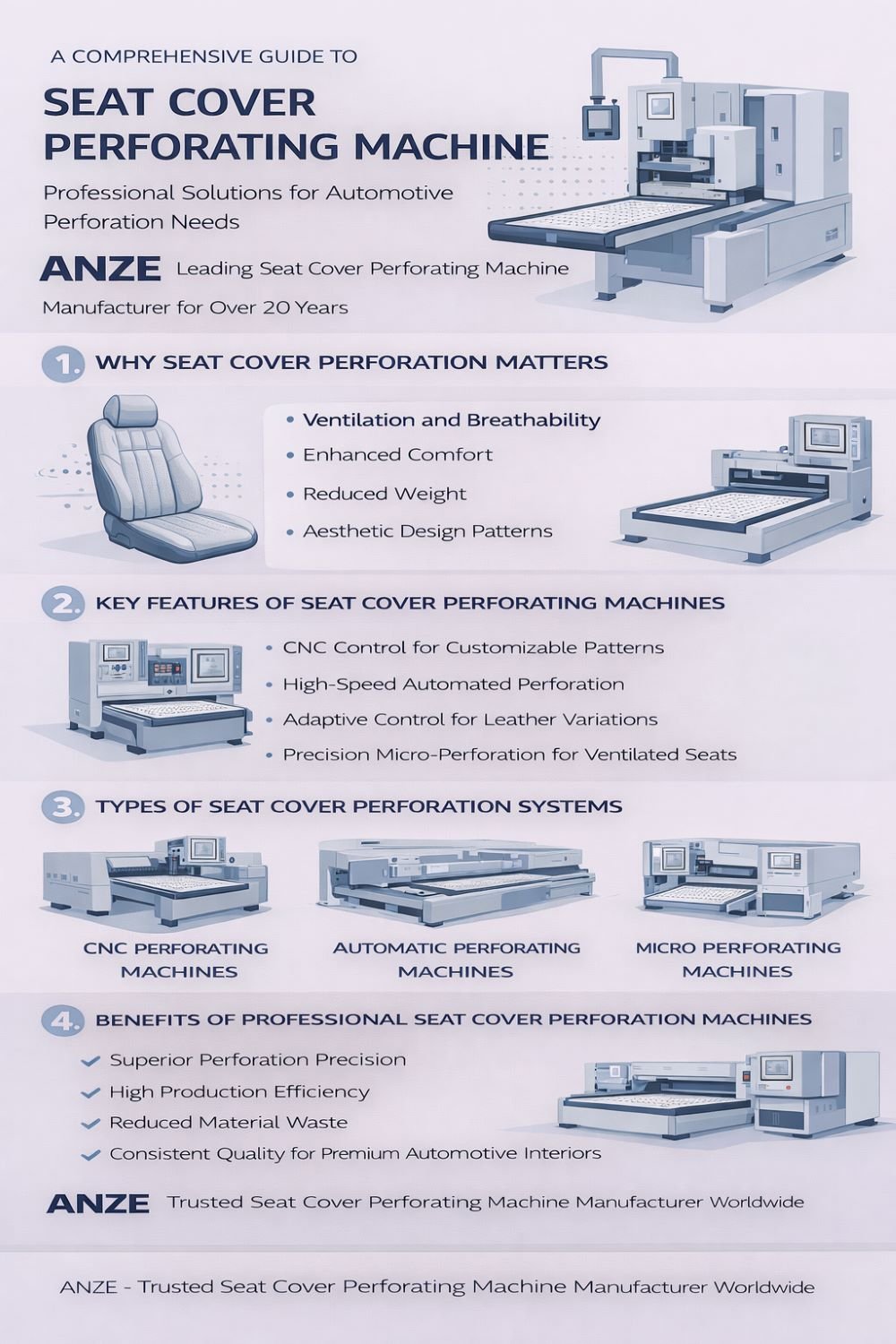
1. Seat Cover Perforating Machine: Why Perforation Is Essential for Automotive Seats
A seat cover perforating machine is designed to create precise, repeatable micro- or macro-perforations in leather and synthetic upholstery materials used for automotive seating.
Key functional reasons for seat cover perforation:
Ventilation and breathability for seat comfort
Compatibility with ventilated and cooled seats
Acoustic transparency for seat-integrated speakers
Weight reduction without strength loss
Aesthetic and branding design patterns
Without a high-precision seat cover perforating machine, manufacturers cannot meet modern automotive interior requirements consistently.
2. Seat Cover Perforating Machine Manufacturer Perspective: Industry Challenges
As a professional seat cover perforating machine manufacturer, Anze has identified several industry-wide challenges:
Variable leather thickness (0.8–1.6 mm)
Natural leather grain inconsistency
Heat sensitivity of PU and microfiber
High-speed production demands
Zero-defect tolerance for OEM automotive supply chains
These challenges require advanced seat cover perforating machine solutions rather than generic punching equipment.
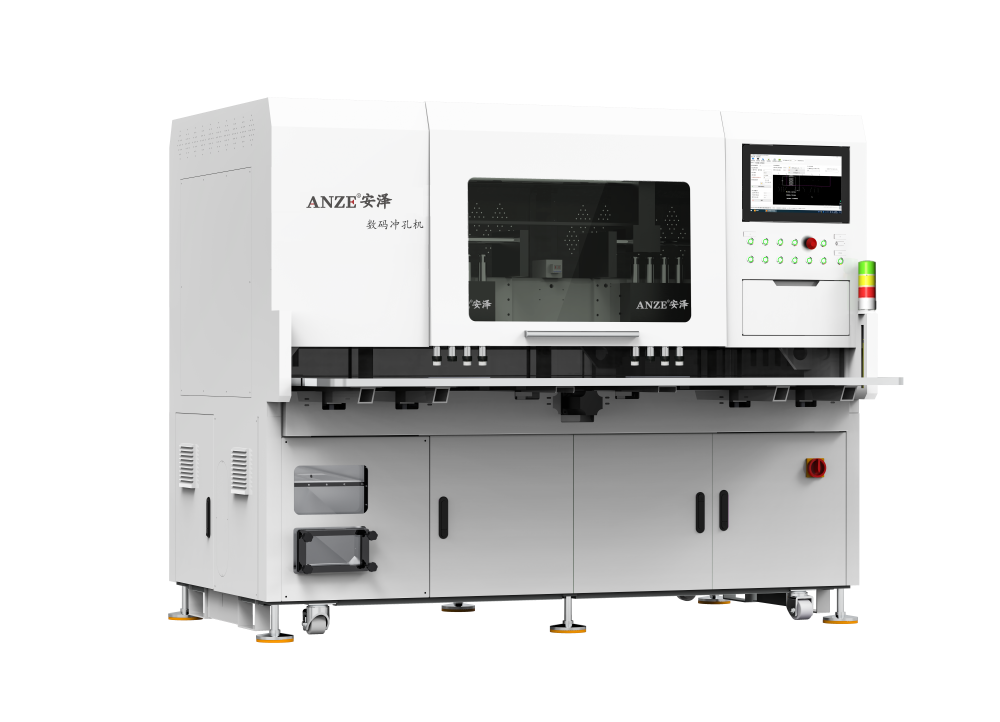
3. Seat Cover Perforating Machine Types Used in Automotive Production
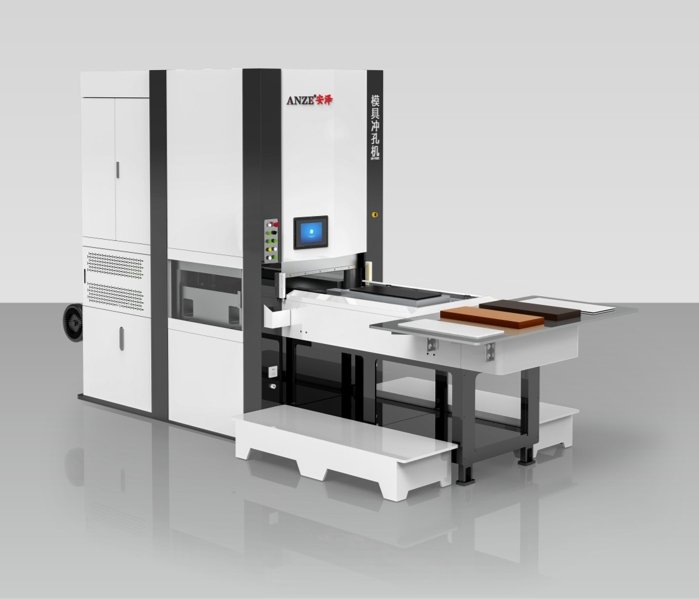
3.1 CNC Seat Cover Perforating Machine
A CNC-controlled seat cover perforating machine provides:
Digital pattern programming
Automatic hole alignment
Variable hole diameter control
High repeatability for mass production
This type is ideal for Tier-1 automotive suppliers.
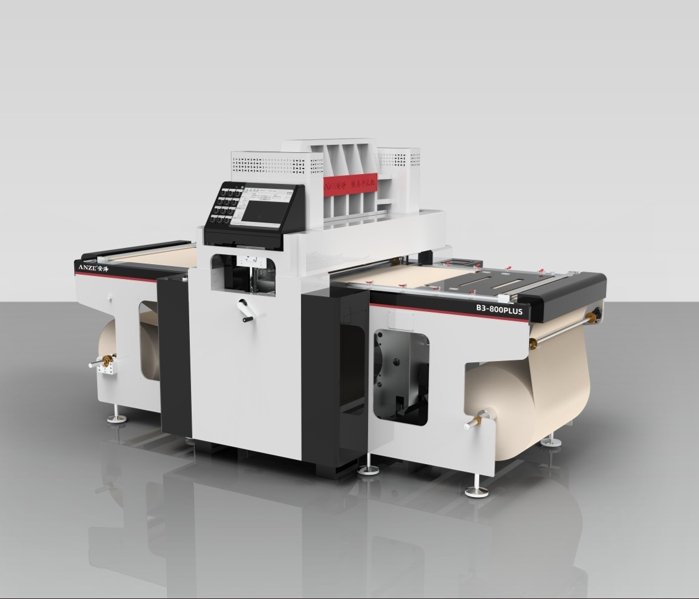
3.2 High-Speed Automatic Seat Cover Perforating Machine
An automatic seat cover perforating machine focuses on throughput:
Continuous feeding systems
Servo-driven punching heads
Up to tens of thousands of holes per minute
Integration with cutting and laminating lines
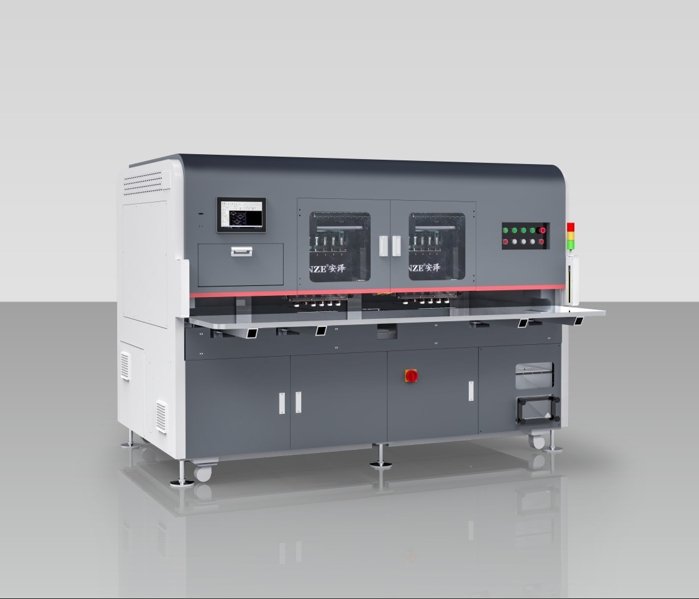
3.3 Micro-Perforation Seat Cover Perforating Machine
Micro-perforation is essential for ventilated seats:
Hole diameters as small as 0.3–0.8 mm
Clean edges without leather tearing
Stable airflow performance
Anze’s micro-perforation seat cover perforating machines are optimized for luxury vehicles.
4. Seat Cover Perforating Machine and Material Compatibility
A professional seat cover perforating machine manufacturer must engineer solutions for diverse materials:
4.1 Genuine Automotive Leather
Full-grain leather
Corrected grain leather
Semi-aniline leather
4.2 Synthetic Upholstery
PU leather
PVC leather
Microfiber composites
Each material requires different:
Punch geometry
Pressure control
Tool speed
Heat management
Anze’s seat cover perforating machines use adaptive control systems to handle material variation.
5. Seat Cover Perforating Machine Process Engineering
5.1 Hole Diameter and Pattern Design
Seat cover perforating machine parameters include:
Hole size (0.3 mm – 3.0 mm)
Hole spacing
Pattern density
Functional zones (ventilation areas vs. structural zones)
5.2 Perforation Accuracy and Tolerance
Automotive standards require:
±0.05 mm hole position tolerance
Clean punching without burrs
No fiber pull-out on microfiber
Anze seat cover perforating machines are designed to meet these tolerances consistently.
6. Seat Cover Perforating Machine for Ventilated Seat Systems
Modern vehicles increasingly adopt ventilated seats. This places strict demands on the seat cover perforating machine:
Uniform airflow channels
No blockage from melted edges
Consistent perforation density
Anze integrates airflow simulation data into seat cover perforating machine pattern design.
7. Seat Cover Perforating Machine Tooling Technology
7.1 Punch Materials
Tungsten carbide
High-speed steel
Coated micro-punches
7.2 Tool Life Optimization
A professional seat cover perforating machine manufacturer designs:
Quick-change tooling
Automated wear monitoring
Tool sharpening cycles
8. Seat Cover Perforating Machine Automation and Smart Control
Anze’s advanced seat cover perforating machine solutions include:
PLC + CNC hybrid control
MES connectivity
Pattern recall
Production data logging
This supports Industry 4.0 manufacturing environments.
9. Seat Cover Perforating Machine Production Line Integration
A seat cover perforating machine rarely operates alone. It integrates with:
Leather cutting machines
Laminating systems
Foam bonding lines
Sewing and assembly stations
Anze provides full seat cover perforating machine line solutions.
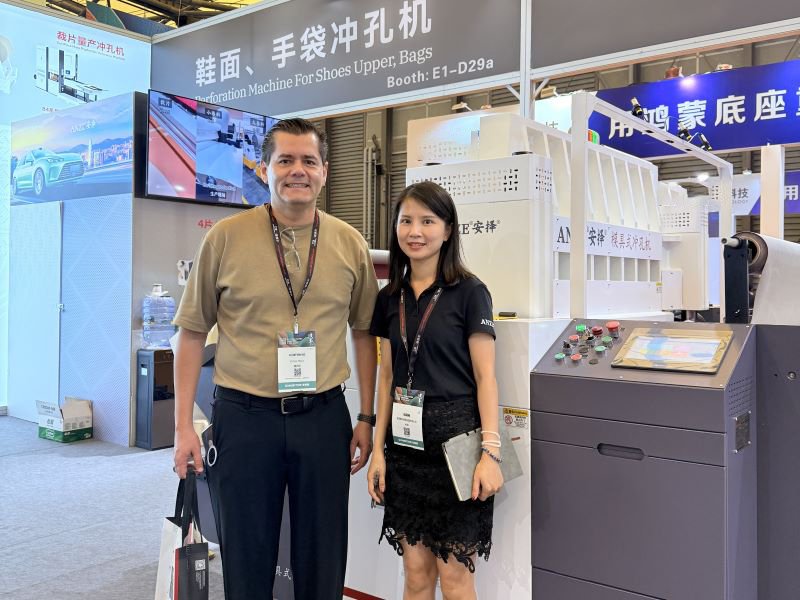
10. Seat Cover Perforating Machine Quality Control Standards
Automotive OEMs require strict QA:
Visual inspection systems
Hole blockage detection
Random airflow testing
Dimensional scanning
Anze designs seat cover perforating machines compatible with inline inspection modules.
11. Seat Cover Perforating Machine Manufacturer: Why Automotive Clients Choose Anze
As a trusted seat cover perforating machine manufacturer, Anze offers:
20+ years of engineering experience
20+ proprietary machine models
Custom tooling development
Global customer support
Proven automotive seat projects
Our seat cover perforating machines are used by manufacturers supplying:
Passenger vehicles
Commercial vehicles
Luxury and premium brands
12. Seat Cover Perforating Machine Case Applications
12.1 Premium Vehicle Seat Covers
Micro-perforation for ventilation
High aesthetic standards
12.2 Mass-Market Seat Covers
High-speed production
Cost-efficient tooling
12.3 Electric Vehicle Seat Systems
Lightweight designs
Enhanced airflow requirements
13. Seat Cover Perforating Machine Cost Factors
Key factors influencing seat cover perforating machine investment:
Automation level
Production capacity
Hole precision
Tooling system
Customization requirements
Anze provides scalable solutions from entry-level to fully automated production lines.
14. Future Trends in Seat Cover Perforating Machine Technology
The next generation of seat cover perforating machines will focus on:
AI-assisted pattern optimization
Adaptive punching force control
Digital twins for process simulation
Sustainable material compatibility
Anze continues to invest heavily in R&D to lead these trends.
Selecting the Right Seat Cover Perforating Machine Partner
Choosing the right seat cover perforating machine is not just about equipment—it is about process reliability, material expertise, and long-term partnership.
With 20 years of experience, proprietary technology, and deep automotive industry knowledge, Anze delivers complete seat cover perforating machine solutions tailored to modern automotive manufacturing demands.
About Anze
Anze is a professional seat cover perforating machine manufacturer specializing in leather, fabric, and flexible material perforation for automotive, furniture, and industrial applications. Our solutions are trusted by manufacturers worldwide for precision, speed, and reliability.
With an experienced and skilled team, we are familiar with all kinds of material characteristics and processing technology, and can customize perforating leather Machine according to customer needs. Any questions please contact us! Whatsapp +86 180 0298 0031
How to install and maintain the machine?
Some models are shipped assembled in the factory. Large equipment is packaged in several parts and an installation manual is provided. All equipment is equipped with user manuals in Chinese and English.
Customers can send someone to anze factory to learn or we send technical experts to provide on-site training
What are the machine working environment requirements?
The CNC Leather Punching Machine should be fixed on a stable table and the environment should be kept clean and tidy to avoid contact with dust, static electricity, humidity, and chips to cause parts failure.
How is your after-sales policies?
We have an experienced after-sales team 24h online service and a completafter-sale system. Factory trainning support, Video technical available to service machinery overseas. support, online support, Engineers.
Are you available for on-the-spot invitation?
Of course we do welcome to visiting our company and have a face-to-face communication to advance mutual business.
What's the delivery time?
Lead time varies depending on the order quantity and customization, typically ranging from 7 to 10 working days.If it is a custom leather punching machine order, it takes 1-2 months.



 English
 Portuguese
 Italian
 Vietnamese
 Russian
 French
 Spanish
 Arabic